
Coaching develops one leader’s behaviour through private, ongoing conversations. Training teaches a group of leaders the same skills, concepts and frameworks in a structured setting. Training transfers knowledge. Coaching changes what a specific person does on Monday morning. If your leaders lack the knowledge, coaching is a poor first spend. If they have the knowledge but keep falling into old habits, training will not fix it.
Most organizations I’ve seen get this backwards. They hire an executive coach for a struggling manager, pay for ten sessions, and discover somewhere around session four that the person never learned how to run a performance review. Nobody taught them. The coach is now a very expensive instructor.
So which should you buy? And when? And how will you know it worked?
Let’s sort it out.
What Is the Difference Between Coaching and Training for Leaders?
Short answer: training is about content, coaching is about the person. One hands over a toolkit. The other watches how you swing the hammer.
Focus and Method
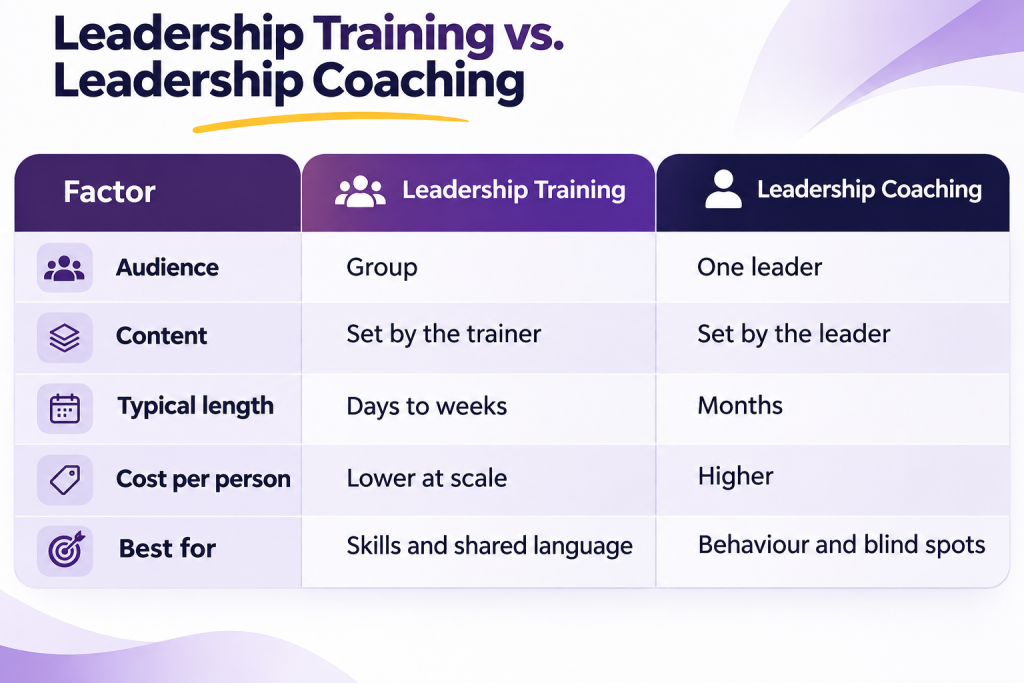
Training runs on a set curriculum. An instructor or trainer decides what matters, builds the workshop, and delivers the concepts through lectures, case studies, role play and group exercises. Everybody in the room gets the same material.
Coaching flips that. The agenda belongs to the leader. As this Harvard Business Review sponsored piece explains, coaching centres on a client-driven agenda and behaviour change rather than a fixed syllabus. The coach asks questions, reflects patterns back, and pushes the leader to find their own answers.
Mentoring sits close by, and people muddle it all the time. A mentor is usually a more experienced person who shares career advice from their own journey, often informally and over a long relationship. Coaching and mentoring overlap, but a coach doesn’t need to have done your job. A mentor usually has. Mentoring programs are lovely for succession and career growth. They are not a substitute for either approach here.
Duration and Cost
Training is short and loud. A two-day workshop, a four-week online course, a quarterly leadership programme. The cost per head drops fast as the group grows, which is why finance teams adore it.
Coaching is slow and quiet. Six to twelve months of coaching sessions, usually once or twice a month, one leader at a time. In Nigeria, a decent executive coach can charge anywhere from ₦150,000 to over ₦500,000 per session, depending on seniority and whether they are international. Training a cohort of twenty managers might cost a fraction of that per person.
Outcomes
Training produces capability: people know a framework, a method, a vocabulary. Coaching produces behavioural changes: people actually act differently under pressure. Those are different animals. You can be fully trained and still shout at your team when a deadline slips.
What Does Leadership Training Do Well?
Plenty. I’m going to defend it, because it gets treated as the boring cousin lately.
Shared Baseline
When forty managers go through the same programme, they walk out with the same words for feedback, delegation and goal setting. That shared baseline matters more than it sounds. Without it, one manager’s idea of “accountability” is another’s idea of micromanagement.
It also matters because managers carry enormous weight. Gallup’s research finds that managers account for about 70% of the variance in team engagement scores. Seventy percent. You cannot leave that to chance or to whoever happened to have a good boss once.
Speed at Scale
You’ve just promoted thirty people in a quarter. Coaching them one by one would take two years and a small fortune. Training gets them all moving in a fortnight.
Practical Know-How
Some things are plainly teachable. How to structure a one-on-one. How to read a budget. How to handle a disciplinary process without landing the company in labour court. Nobody should have to discover these through “powerful questions.” Just teach them.
What Does Leadership Coaching Do Well?
Coaching earns its reputation when the problem is personal and specific.
Individual Behaviour Gaps
A training room can’t tell that you interrupt people when you’re anxious. A coach can, usually within two sessions. That kind of awareness is nearly impossible to get from a slide deck. The Harvard Business Review survey of 140 leading coaches also shows coaching has moved from fixing toxic behaviour toward growing high-potential people, which tells you where the real value sits.
Accountability on the Job
Coaching happens in the middle of real work. A leader commits to something on Tuesday and reports back in three weeks. That follow-up is the whole trick. Workshops end; the coaching relationship doesn’t, so skipping the commitment gets awkward.
Sustained Habit Change
Habits take months to rewire. The ATD blog on the training effectiveness gap notes that only about 35% of people rate traditional skills training as very effective, against roughly 60% for coaching. I’d read those numbers with a pinch of salt, since they’re self-reported, but the direction is hard to ignore.
Why Should Leaders Be Trained Before They Are Coached?
Because coaching assumes the raw material is already there.
Here’s my honest, slightly contrarian view. Executive coaching is overrated. It gets sold as a magic fix, yet it costs more, takes longer and is far harder to scale than almost anything else in your development budget. That is a lot of money to spend before you know whether you’re dealing with bad habits or a plain knowledge gap.
Think about it. A first-time manager who has never been shown how to give feedback does not need a thinking partner. She needs to be shown how. Put her in coaching first and you get lovely, reflective conversations about skills she was never taught. Everyone feels good. Nothing changes.
So I’d train first, build the baseline, then bring in coaching for the specific behaviour gaps that show up on the job. Training is the foundation. Coaching is a targeted tool, not the whole plan.
When Should You Choose Coaching, Training, or Both?
Match the intervention to the problem. Sounds obvious. Rarely done.
Choose Training When
- Leaders are new to the role or newly promoted
- Many people share the same skills gap
- The need is technical or procedural, such as compliance, safety or budgeting
- You need consistent language across the organization quickly
Choose Coaching When
Pick coaching when the knowledge exists but the behaviour doesn’t follow. A senior leader who knows how to delegate and still hoards work. A brilliant engineer, newly a director, who can’t let go of the technical details. Also for a major transition, like a move into the C-suite, where the challenges are unique and the stakes are high.
Combine Both When
You’re building a succession pipeline, preparing high-potential employees for bigger roles, or running a culture change where everyone needs the same framework and a few people need individualized support to model it.
How Do You Combine Coaching and Training?
Sequence them. Run the workshop first. Then, four to six weeks later, once people have tried the ideas and stumbled, bring in coaching sessions to work through what actually happened.
Some organizations flip it and use short group coaching after training to keep the content alive. That works well, and it’s cheaper than one-on-one. Google’s Project Oxygen is a good reference; this HBR podcast on improving management at Google describes how structured learning and individual development were stitched together rather than treated as rivals.
And please, give line managers a role. If a leader returns from a programme and their own boss never asks about it, the learning dies quietly. HBR’s discussion of workflow-embedded learning points the same way: guidance tied to real work beats theory delivered in isolation.
How Do You Measure the ROI of Each Approach?
Start before the programme, not after it. Pick two or three behaviours and a business metric tied to them. Retention on a manager’s team. Engagement scores. Time to fill a vacancy. Then collect a baseline through 360 assessments and manager feedback.
For training, measure in layers: did people attend, did they learn, are they applying it at 90 days, and did a business number move? Most organizations stop at layer one, which is basically counting chairs.
For coaching, track the goals the leader set at the start and check them with stakeholder feedback at three, six and twelve months. Be wary of the glossy figures, too. You’ll see claims of 86% of organizations recouping their investment or of returns around seven times cost, and Intel’s reported $1 billion annual operating margin contribution. Interesting, yes. Yet most of this data is self-reported by people who sell or buy coaching. Use it as a prompt for your own measurement, not a promise.
One more thing. ROI for training tends to show up quickly but fades without reinforcement. ROI for coaching shows up late but sticks. Plan your review dates around that.
What Mistakes Should You Avoid When Choosing Development?
Buying coaching as a reward for senior people, with no goal attached. Common, and costly.
Sending everyone to the same workshop regardless of need. Wasteful, and people notice.
Treating mentoring as free coaching. A kind senior colleague is wonderful, but without structure and a clear aim, it drifts into pleasant chats.
Skipping the measurement plan because “development is hard to measure.” It is hard. Do it anyway.
And finally, expecting a single intervention to fix a culture problem. If the system rewards bad behaviour, no amount of coaching or training will win.
FAQ
Is coaching better than training for leaders?
Neither wins outright. Training is better for building shared skills and knowledge quickly. Coaching is better for changing individual behaviour. Since you can’t coach what a leader was never taught, I’d start with training and add coaching for targeted gaps.
What is the difference between coaching and mentoring?
A coach helps you find your own answers through questions and accountability, and doesn’t need to have done your job. A mentor shares advice from their own experience, usually over a longer, looser relationship focused on career growth.
How long does leadership coaching take to work?
Expect six to twelve months for lasting behaviour change. Early awareness shows within weeks, but habits take longer to settle.
Can small businesses afford this?
Yes, with sense. Use group training and internal mentoring programs first. Hire an external coach only for one or two critical leaders with a clearly defined problem.
How do I know if my leaders need training or coaching?
Ask whether they know what to do. If they don’t, train. If they know and don’t do it, coach.
Conclusion
Training and coaching are not rivals. They answer different questions. Training asks, “Do you know how?” Coaching asks, “Why aren’t you doing it?”
Spend on the first before the second, measure both from day one, and keep your expectations honest. Get the foundation laid, then bring in coaching where it’s earned.
So what is your biggest leadership gap right now: knowledge, or follow-through?