
Most companies pick a talent assessment workshop provider the same way they pick a hotel for a conference: nice photos, familiar name, decent price. Then they wonder why six months later nobody can point to a single hiring or promotion decision that got better.
So how do you evaluate and select a provider properly? Test the science first (validity, reliability, norms), then the facilitators, then fit with your workflow, data security and cost. Run a pilot before you sign anything big. Score every shortlisted vendor in a weighted decision matrix and drop whoever is selling reputation instead of evidence.
Sounds simple. It isn’t, because the market is full of polished decks and thin research.
I have sat through enough vendor demos in Los Angeles and on video calls with teams across Lagos, Nairobi and London to know the pattern. The slides are gorgeous. The technical manual, when you finally ask for it, is either missing or 12 pages of marketing. Let’s fix that.
What Criteria Separate Strong Providers From Weak Ones?
Three things. Science, consistency and the humans in the room. Everything else (the app, the branding, the free coffee mug) is decoration.
Scientific Validity
Validity is the whole game. A workshop built on tests or simulations that don’t measure what they claim, or don’t predict job performance, is an expensive group activity. Nothing more.
Ask for two kinds of proof. Construct validity says the instrument measures the trait it names, say cognitive ability or personality. Criterion validity says scores actually predict something real, like performance ratings or retention. SHRM’s guidance on evaluating hiring assessments pushes the same line: independent, empirical evidence beats proprietary “black box” claims every time.
If a vendor says “our model is proprietary, trust us,” I’d walk. Frankly, I’d walk fast.
Reliability and Norms
Reliability is about consistency. Would the same person get roughly the same result next month? Would two assessors watching the same simulation score it alike? You want internal consistency figures, test-retest data and, where the format uses assessors, inter-rater agreement. A single facilitator’s gut feeling dressed up as science is not measurement.
Norms are the quiet killer. If the comparison group was built from, say, American graduate engineers and you are assessing frontline supervisors in Abuja, those percentile scores mean very little. Worse, they carry legal and fairness risk. Ask who is in the norm group, when it was collected, and how big it is.
Facilitator Credentials
Who actually runs the room? Ideally Industrial-Organizational (I-O) psychologists or practitioners with proper accreditation in the instruments they use, plus data people who can interpret the output. A dashboard cannot explain to a nervous manager why her scores look the way they do. A person can.
Ask about certification, supervised practice, and how many workshops each facilitator has delivered in your sector. Then ask to meet them. Not the sales lead. Them.
How Do You Define What the Workshop Must Achieve?
Before you email a single vendor, get your own house in order. SHRM’s advice on knowing what is needed before choosing assessment tools makes the point well: if you cannot say what decision the assessment will inform, any provider will look good.
Business Outcomes
Write down the outcome in plain words. Faster hiring? Better succession pipeline? Fewer failed promotions? Pick one or two, attach a number, and tie them to your wider talent strategy. If the output is “better insights,” you have not defined anything yet.
Target Audience and Stage
High-volume graduate screening wants something short and low-friction. A senior leadership workshop can go deeper, with simulations, structured interviews and multi-assessor panels. Mixing those up is a classic blunder. Define who is being assessed, at what stage of the employee lifecycle, and in what language and device conditions. In many Nigerian and wider African settings, mobile-first access and patchy bandwidth are not edge cases. They are the norm.
Budget and Constraints
Set the ceiling in naira (or your own currency) early, and count everything: licences, facilitator fees, travel, translation, internal time. Note the constraints too, like data residency rules and the Nigeria Data Protection Act 2023, which affects how participant data is stored and moved across borders.
How Do You Verify a Provider’s Evidence?
Trust, then verify. Mostly verify.
Technical Manuals
Every legitimate instrument has one. It should show development history, sample sizes, validity coefficients, reliability figures and known limits. The SIOP Principles are the reference point for professional standards, and the ISO 10667 standard on service provider requirements gives you a global benchmark for competence, data handling and delivery. If a provider can’t speak to either, that tells you plenty.
Demographic Fit and Fairness
Ask for adverse impact analysis by gender, age and, where lawful and relevant, ethnicity or language group. The CIPD selection methods factsheet is a decent yardstick for what unbiased, evidence-based practice looks like. With AI-driven scoring creeping into platforms, the SIOP piece on algorithmic bias and construct validity is worth a read before you accept any “machine-scored” claim.
Reports and Analytics
Ask for a sample report on a dummy participant. Can a busy line manager understand it in ten minutes? Does it translate scores into behaviour and development actions, or just throw radar charts at you? Check export options and whether analytics can be cut by team, role or cohort.
Follow a Five-Step Selection Process
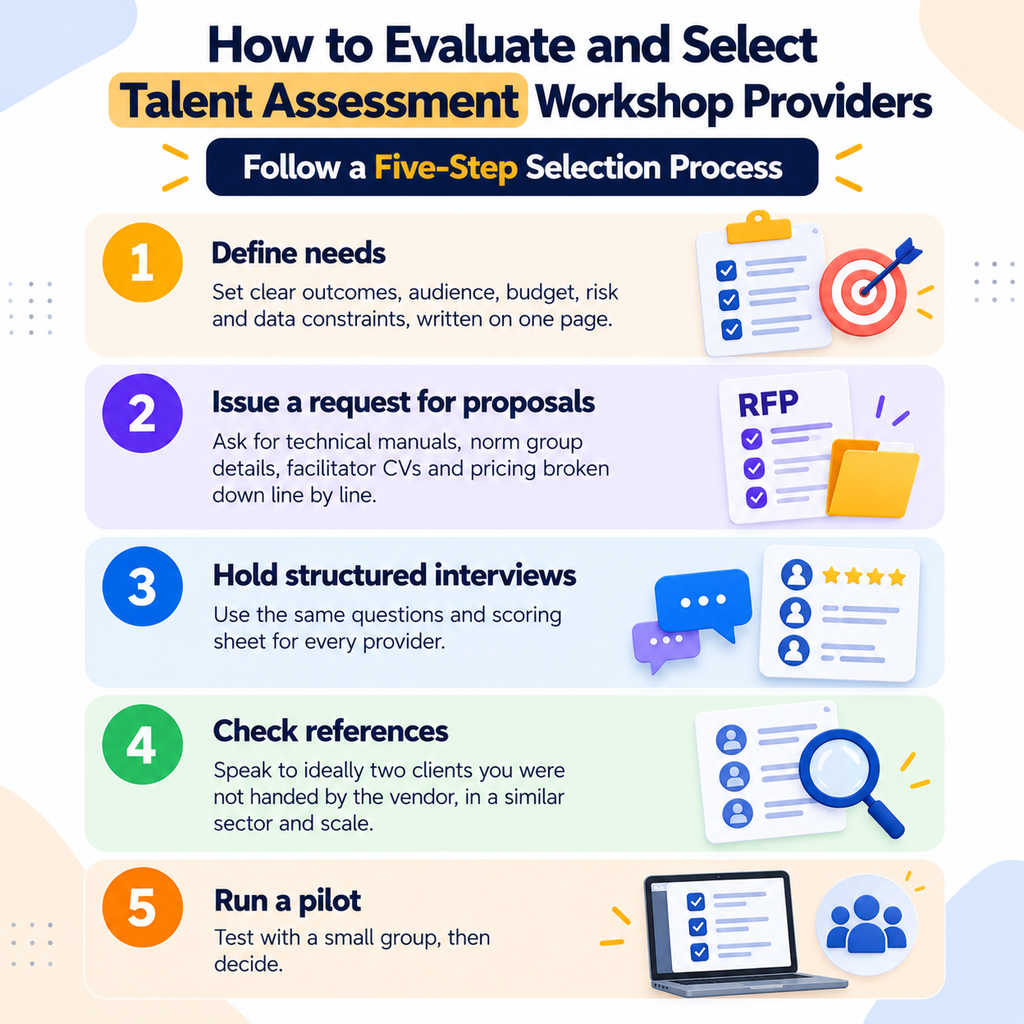
Here is the sequence I’d use, and I would not skip a step to save time.
- Define needs: outcomes, audience, budget, risk and data constraints, written on one page.
- Issue a request for proposals asking for technical manuals, norm group details, facilitator CVs and pricing broken down line by line.
- Hold structured interviews using the same questions and scoring sheet for every provider.
- Check references, ideally two clients you were not handed by the vendor, in a similar sector and scale.
- Run a pilot with a small group, then decide.
The Workforce Group guide on selecting a talent assessment company lines up well with this, especially on verifying validity studies and reporting depth. Reference calls deserve more attention than they get. Ask what went wrong, not what went well. Everyone’s project went well on the brochure.
Build a Weighted Decision Matrix
Gut feel will drift toward the best presenter. A matrix drags you back to evidence. Weight the categories before you see any proposals, otherwise you will unconsciously rig the weights for your favourite.
| Category | Suggested Weight | What Good Evidence Looks Like |
|---|---|---|
| Scientific validity and reliability | 30% | Technical manual, peer-reviewed or independent studies |
| Facilitator quality | 20% | I-O psychologists, accreditation, sector experience |
| Customisation and workflow fit | 15% | Tailored competencies, ATS or HRIS integration |
| Data security and compliance | 15% | Clear policy, NDPA and ISO-aligned practice |
| Measurable impact | 10% | Case data with real before-and-after figures |
| Cost-effectiveness | 10% | Total cost of ownership, not headline price |
Notice cost sits at the bottom. That is deliberate. Cheap and invalid is still expensive, just later.
What Questions Should You Ask Every Provider?
Keep them blunt. What validity coefficients do you have for roles like ours, and who produced the studies? Who is in your norm group? How do you handle adverse impact? Who delivers the workshop, and can we interview them? Where is our data stored, who can access it, and what happens when we leave? What does a typical failed engagement look like, and why did it fail?
That last one is my favourite. Honest providers answer it. Defensive ones reveal themselves.
Spot Red Flags and Avoid Common Mistakes
Watch for vague “proprietary algorithm” language, no technical manual, norms that do not resemble your people, and testimonials with no numbers. Be suspicious of one-size-fits-all packages promising to assess everything from leadership to coding in one afternoon. Also, a provider who dodges the facilitator question is hiding a thin bench.
The mistakes are usually yours, not theirs. Buying on price. Skipping the pilot because the launch date is fixed. Letting HR choose alone when the hiring managers who will use the reports were never consulted. And treating the workshop as an event rather than part of a talent system, which brings us to the next bit.
Should You Pilot Before Signing a Contract?
Yes. Always. Even a small one.
Pick 15 to 30 participants across the target role. Watch the candidate experience: is the process fair, clear and free from pointless friction? Collect feedback from participants and managers on report clarity. Compare results against what managers already know about these people. If the scores contradict everything your best supervisors say, dig into why before you scale. Negotiate pilot fees as credit toward the full contract. Good providers agree. Others hesitate, and that hesitation is data.
What Should You Consider After Selecting a Provider?
Contract terms first. Lock in data ownership, deletion timelines, service levels, named facilitators (so you don’t get the junior swapped in), and an exit clause. Then plan implementation: train internal recruiters and managers to read reports, set review dates, and track the outcomes you defined at the start, such as quality of hire, promotion success and retention. Strategy+Business style thinking applies here: tie competencies back to business strategy, or the whole thing drifts.
Review at 6 and 12 months. If the numbers don’t move, ask hard questions. Loyalty to a vendor is not a strategy.
Conclusion
The best provider is rarely the loudest one. Pick the vendor who proves the science, fits your workflow, staffs real experts and is open about data security. Score them in a matrix, test them in a pilot, and bin anyone who sells reputation over evidence.
What would your shortlist look like if you removed every logo from the proposals?