
A personal or leadership development plan is a written roadmap that links a person’s growth targets to the real work they do, with specific actions, a timeline, and a way to check whether any of it helped. That’s the answer. Everything else in this guide is about making that roadmap worth the paper, or the spreadsheet, it lives on.
Organisations invest heavily in these plans, and yet many sit untouched in a shared folder by March. The idea is sound. The execution is usually lazy. What follows covers how to build a plan that survives contact with a busy calendar, for an individual leader and for the team around them.
What Makes a Development Plan Worth Keeping?
A plan is worth keeping when it changes what someone does on Monday morning. If it only changes what they write in an annual review, bin it.
Personal Plan Versus Leadership Plan
A personal development plan covers the whole person: skills, career goals, habits, even the boring stuff like how you handle email. A leadership development plan (LDP) narrows the lens to how you influence others, make decisions under pressure, and handle conflict. Both can be called an individual development plan, or IDP, which muddies things a little.
Neither is a training catalogue. Courses and workshops can feed a plan, but they are inputs, not the plan.
Benefits for Leaders and Teams
For the leader, the gain is self-awareness and sharper judgment. Research in the Journal of Values-Based Leadership frames this as vertical development, meaning you change how you process complexity rather than just stacking up new skills. That matters when your week is a pile of competing priorities.
For the team, the payoff is a manager who coaches. People stop guessing what “next level” means because someone has pointed at it.
Benefits for the Organisation
Retention and succession. DDI reports that structured leadership development builds bench strength and keeps high-potential staff at roughly twice the rate of unguided settings.
I’ll be blunt about that 2.4X figure floating around conference slides. A number doesn’t rescue a bad program. It only holds where the culture is supportive and each person can see a clear next step.
Why Do Most Development Plans Fail?
Because they were built to satisfy HR, not to change behaviour. Three culprits show up again and again.
Generic Goals and Checklists
“Improve critical thinking.” “Strengthen organisational skills.” Lovely phrases, impossible to act on. A six-month plan stuffed with goals like these produces a nicer-looking spreadsheet and nothing else.
Mandatory e-learning dressed up as growth belongs in the same bin.
Weak Manager Involvement
Here the numbers are grim. Gallup’s workplace research suggests only 44% of managers worldwide have ever had formal management training. So we ask people who were never taught to coach to run a coaching-heavy process. Of course it stalls.
When managers do back development, trust moves. DDI’s forecast research found employees are 11 times more likely to trust a manager who supports their growth.
Plans Disconnected From Real Work
If the plan never touches an actual project, a hard client, a messy restructure, it’s homework. Development happens inside the work. Anything else is a hobby.
How Do You Build an Effective Development Plan?
Start with honesty, finish with practice. In between, keep it small.
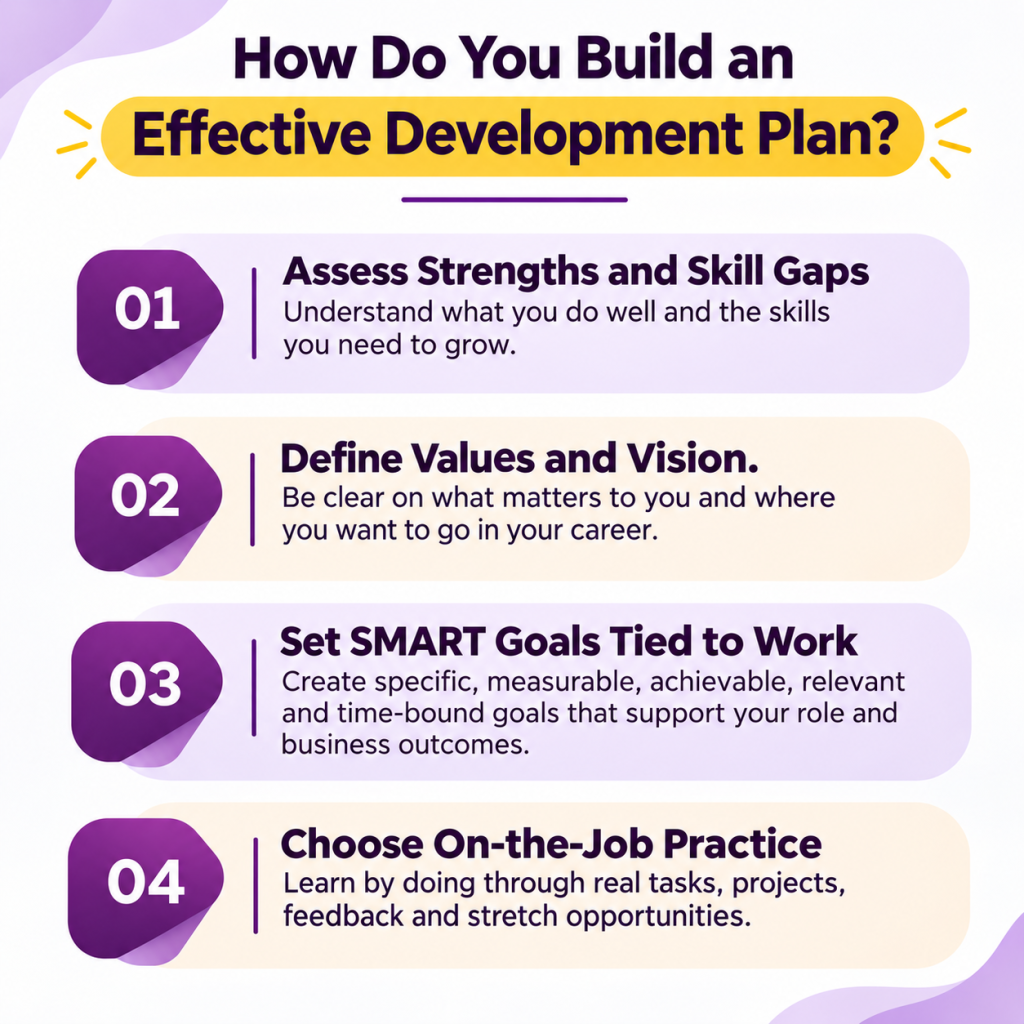
Assess Strengths and Skill Gaps
Collect evidence before opinions. A 360-degree feedback round, a few honest talks with peers, a look at your last two performance reviews. Ask what complexity you handle badly. Where do decisions stall? Where does your emotional intelligence slip when someone pushes back?
Pick two or three gaps. Not eight.
Define Values and Vision
This step gets skipped because it feels soft. Skip it and the plan drifts. Write down your core values and the kind of leadership style you want people to describe when you leave the room. Self-determination theory, by Deci and Ryan, says lasting motivation comes from autonomy, competence, and relationships. A plan that ignores those will feel like a chore by week three.
Set SMART Goals Tied to Work
SMART goals (specific, measurable, achievable, relevant, time-bound) still earn their place, provided the “relevant” part means a live business problem. “Run every fortnightly one-to-one with a coaching question instead of a status update, for four months” beats “be a better communicator” every time.
Choose On-the-Job Practice
Pick the stretch task. Lead the cross-department review. Mediate the conflict you have been dodging. Pair it with mentorship or a peer who will tell you the truth afterwards.
What Should a Development Plan Contain?
Less than you think, but every piece has a job.
Core Components
- A short statement of your current strengths and the gaps you chose.
- Two or three development goals written in SMART form.
- The on-the-job activity for each goal.
- Support: who coaches, who gives feedback, which resources you need.
- Milestones, a timeline, and the evidence you’ll use to judge progress.
Template Layout
One page. Seriously. Columns work well, and a simple development plan template looks like this:
| Goal | Work situation | Action steps | Support | Evidence | Review date |
|---|---|---|---|---|---|
| What changes | Where you’ll practise | What you’ll do | Coach, peer, resource | How you’ll know | Fixed date |
Example Entries
A finance director wants stronger delegation. Goal: hand off monthly reporting to two team members within ninety days. Practice: weekly handover sessions. Evidence: her own hours drop and error rates stay flat. Review: day 45 and day 90.
A new operations lead, based in Lagos, struggles with empathy under deadline pressure. Goal: open each tense meeting with one question about workload. Support: a mentor from another department. Evidence: pulse feedback from team members after six weeks.
How Can Teams Plan Development Together?
Individually written plans can pull a team in six directions. Somebody has to stitch them.
Align Individual and Team Goals
McKinsey’s work on team empowerment points to a clear mandate and aligned outcomes as prerequisites. Translate that: what does the team need to deliver this year, and which skills does each person need to make it happen? Put those two lists side by side. Gaps show up quickly.
Set Coaching Rhythms
Fortnightly, thirty minutes, one plan item on the table. The manager asks, listens, and offers one observation. That’s the whole ritual. It beats a glossy quarterly workshop.
Create Room to Practise
Nobody practises delegation with a calendar booked solid. Release time. Reduce a deliverable. Protect the learning slot like a client meeting.
How Do You Track Progress and Stay Accountable?
Track behaviour, not attendance. Certificates tell you someone sat down.
Choose Evidence-Based Measures
Choose two or three markers per goal. Meeting turnaround time, the number of decisions delegated, team survey scores, stakeholder comments. Mix numbers with stories.
Gather Feedback
Ask the people affected, not just the boss. Short pulse questions at the midpoint work well. Be warned: only about 39% of employees say their manager gives clear developmental feedback, according to Gartner, so don’t assume it happens by itself. Schedule it.
Run Review Conversations
Hold them at fixed dates, with the plan open on the table. Three questions: What did you try? What happened? What changes now? Adjust the plan freely. A plan that never changes was probably never used.
Which Pitfalls Can Increase Stress and Burnout?
Overloading. A plan with eight goals on top of a full workload is a recipe for exhaustion, and burnout turns development into a punishment.
Other traps: treating the plan as an appraisal weapon, setting targets with no grounding in capacity, and expecting the leader to do all this in evenings. TalentLMS found 64% of HR managers call leadership training a core priority, which is wonderful, but priority without protected time just adds pressure.
What Should You Ask Before Committing to a Plan?
Ask yourself a few awkward questions first:
- Which real problem at work will this plan help me solve?
- Who will coach me, and have they agreed?
- What will I stop doing to make room?
- How will I know, in plain terms, that something improved?
If you can’t answer them, you’re about to write paperwork.
FAQ
What is the difference between an IDP and an LDP? An individual development plan covers any employee’s growth. A leadership development plan focuses on leading others and future leaders’ readiness for bigger roles.
How long should a plan run? Three to six months for the active goals, reviewed every four to six weeks. Longer horizons suit career goals, not action steps.
Do teams need their own plan? Yes. A shared team development plan should sit above individual ones and show how each person’s growth supports the work.
How many goals are enough? Two or three. More than that and nothing gets practised.
Who owns the plan? The individual owns it. The manager owns the coaching and the room to practise.
Conclusion
A good development plan is small, personal, and tied to work that already exists. It needs a manager who actually coaches, a culture that allows practice, and evidence beyond a completed course. Skip the box-ticking, pick one real challenge, and start there. What’s the first conversation you’ll have this week?