
Every conference organizer knows the feeling: a schedule packed so tightly with sessions that attendees leave exhausted, having absorbed little and connected with almost no one.
Poorly balanced schedules are one of the quietest but most damaging mistakes in conference planning, they cause attendee fatigue, low session engagement, and weak Return On Investment (ROI) for sponsors, speakers and attendees alike.
A successful HR conference is built on three essential pillars: Inspiration (keynotes), Education (breakouts) and Connection (networking). The most frequent planning error is focusing too heavily on one pillar typically the content while neglecting the other two. This guide provides a step-by-step framework, based on rhythm and balance, to design a schedule that delivers value to every attendee, whether the event is in-person, virtual or hybrid.

The “Rhythm” Principle: Why Timing Is More Important Than Content
Before deciding what goes on the agenda, decide how time itself should move through the day. Content quality matters less than most organizers assume if the rhythm around it is wrong.
The 90-Minute Attention Span
Cognitive research on attention consistently points to a similar conclusion: the brain can sustain intense, focused attention for roughly 90 minutes before performance drops sharply. Session blocks especially deep-dive or workshop formats should respect this ceiling rather than fight it.
The Energy Curve
Attendee energy naturally fluctuates throughout the day; plan your design to align with these variations:
- Morning – Absorption: keynotes and deep-dive sessions, when focus is freshest.
- Afternoon – Application: workshops and networking, when people want to move and interact.
- Late afternoon – Reflection: round-tables and informal chats, when energy is lower but social bandwidth is high.
The Buffer Is Sacred
A 15–20 minute buffer between sessions is not wasted time; it is intentional design. These buffers provide a cognitive reset, facilitate smooth room transitions, and create space for spontaneous hallway conversations often rated by attendees as the most valuable part of the event. Eliminating buffers to fit in an extra session is the leading cause of audiences feeling burnt out by 2 PM.
The Golden Rule: 50/30/20 Split
Once the rhythm is established, distribute time using a straightforward ratio throughout the entire schedule, not only during formal sessions:
- 50% Education (breakouts and workshops) – the primary value proposition for the majority of attendees.
- 30% Connection (networking and breaks) – the key element that fuels repeat attendance.
- 20% Inspiration (keynotes and plenaries) – sets tone and delivers the big-picture narrative.
This means a full eight-hour conference day should carry roughly 90 minutes of keynote content, 4 hours of breakouts and nearly 2.5 hours dedicated to structured connection and breaks. Most schedules invert this ratio, this framework corrects it.
Step 1: Anchor Your Day with the Keynote
Morning Anchor
Place the keynote as the first major event of the day, ideally 9:00–10:00 AM, after a brief registration. This sets the theme, energizes the room and gives every subsequent session a shared reference point.
The “No-Session” Window
Never schedule breakout tracks against the keynote. Fragmenting the room during the one moment meant to unify it undermines the entire purpose of a plenary session, everyone should be having the same experience at the same time.
The Keynote Echo
Immediately after the keynote, build in a 15-minute “echo”, a structured reflection break, not a rush to the next room. A simple prompt (“What is the one idea you are taking into today?”) turns a passive listening experience into an active, discussed one and naturally seeds the networking that follows.
Step 2: Design the Breakout “Menu” (The 3-Track Model)
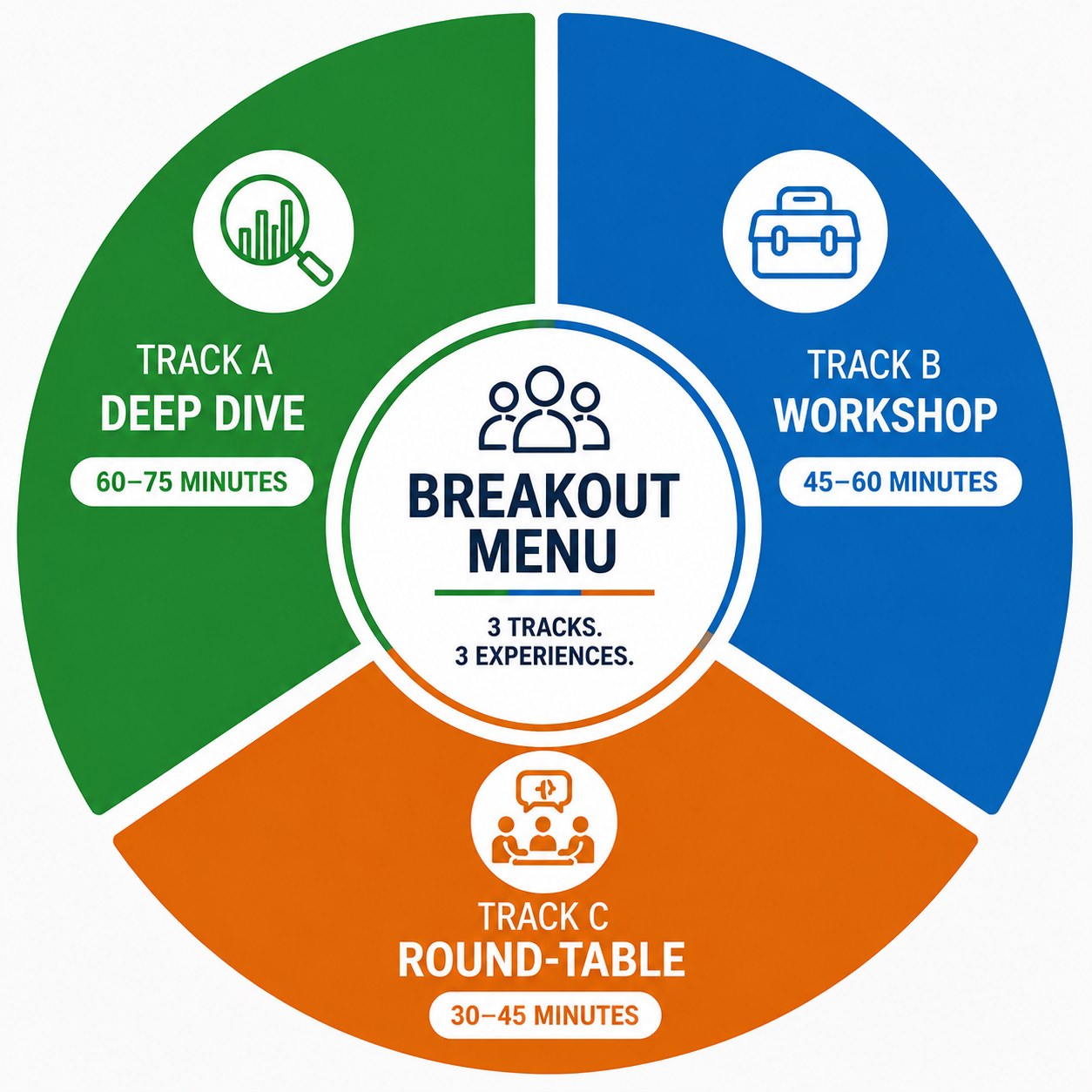
A single breakout format fails a large share of any HR audience. Different attendees learn differently, so the breakout menu should offer three distinct tracks running in parallel:
Track A – “Deep Dive” (60–75 minutes)
This is designed for experienced professionals who want case studies, data and complex problem-solving. This is the track for people who already know the basics and want nuance.
Track B – “Workshop” (45–60 minutes)
This is designed for hands-on learners. Templates, tools, and group activities belong here, attendees should leave with something tangible they can apply on Monday morning.
Track C – “Round-table” (30–45 minutes)
This is designed for connectors. A facilitated discussion format built around peer learning, where the value comes from the room’s collective experience rather than a single speaker’s slides.
The “Open Slot” Rule
Leave at least one unscheduled 30-minute slot per day. No panel, no workshop, just space. This is where serendipitous meetings, quiet reflection or a missed conversation from earlier in the day can happen. It looks like a gap in the agenda; it is actually one of the highest-value slots in it.
The Networking Bridge: How to Force the Connection
Networking rarely happens well when left to chance as generic “free time.” It needs structure, often described as an HR Expo Africa-style approach to event design, where connection is treated as a scheduled deliverable, not an afterthought:
- Speed Networking Slot: a 20-minute structured session after lunch or before the closing keynote, guided by one simple prompt to keep conversations moving.
- Interest-Based Lunch: label tables by topic (e.g., “Talent Acquisition,” “People Analytics”) instead of open seating. This gives introverts an easy, low-pressure entry point into conversation.
- Post-Session Social: end breakouts five minutes early on purpose. That short window creates informal “hallway huddle” time before the next block begins, often where the most candid conversations of the day happen.
Step 3: The “Wind-Down” and Post-Conference Nurture
Late Afternoon Lull
Avoid scheduling heavy, cognitively demanding content after 4:00 PM, this is exactly when the energy curve dips. Replace dense sessions with lightning talks, a moderated panel Question & Answers, or a structured reception that lowers the bar for participation while keeping people in the room.
The Call to Action
Close the day with something specific, not vague. “Connect with three people on LinkedIn,” “fill out this feedback form,” or “sign up for tomorrow’s workshop” gives attendees a concrete next step instead of a passive goodbye.
The Long Tail
The schedule’s job doesn’t end when the venue closes. A short post-conference email sequence that includes recordings, slide decks and a link to an ongoing community extends the value of the day and turns a single event into an ongoing relationship.
Sample 1-Day Schedule: The “Balanced” Model
Here is how the framework looks applied to a real agenda with each block labeled by pillar:
- 8:30–9:00 — Registration & Coffee (Connection)
- 9:00–10:00 — Opening Keynote (Inspiration)
- 10:00–10:15 — Keynote Echo & Buffer (Connection)
- 10:15–11:30 — Breakout Block 1: Deep Dive / Workshop / Round-table (Education)
- 11:30–11:50 — Buffer & Transition (Connection)
- 11:50–1:00 — Interest-Based Lunch (Connection)
- 1:00–2:00 — Breakout Block 2: Deep Dive / Workshop / Round-table (Education)
- 2:00–2:20 — Speed Networking Slot (Connection)
- 2:20–2:50 — Open Slot (unscheduled) (Connection)
- 2:50–3:45 — Breakout Block 3 (Education)
- 3:45–4:15 — Lightning Talks / Panel Questions & Answers (Inspiration)
- 4:15–5:00 — Closing Reception & Call to Action (Connection)
Total it up and the ratio holds close to 50% education, 30% connection and 20% inspiration, proof that the framework isn’t abstract, it’s scheduled.
Conclusion
A conference schedule is a contract with the attendee: a promise that their time and energy will be respected. Scheduling isn’t logistics, it is designing a journey through inspiration, education and connection. Apply the 50/30/20 blueprint to your next HR conference and watch engagement, not just attendance, This becomes the metric you win on.