AI is changing how HR work gets done.
From writing job descriptions and screening applications to analysing employee data and supporting workforce planning, AI tools are becoming part of everyday HR work
The true benefit is derived from knowing when to use AI, learning how to question the results it produces, how to safeguard people and data, and knowing when human judgment should take over.
For HR professionals all over Africa, this is turning into an important career skill.
The future of HR won’t be merely concerned with HR professionals using AI skill.
The subject will be HR professionals who are able to work effectively with AI and at the same time keep people at the heart of all decisions.
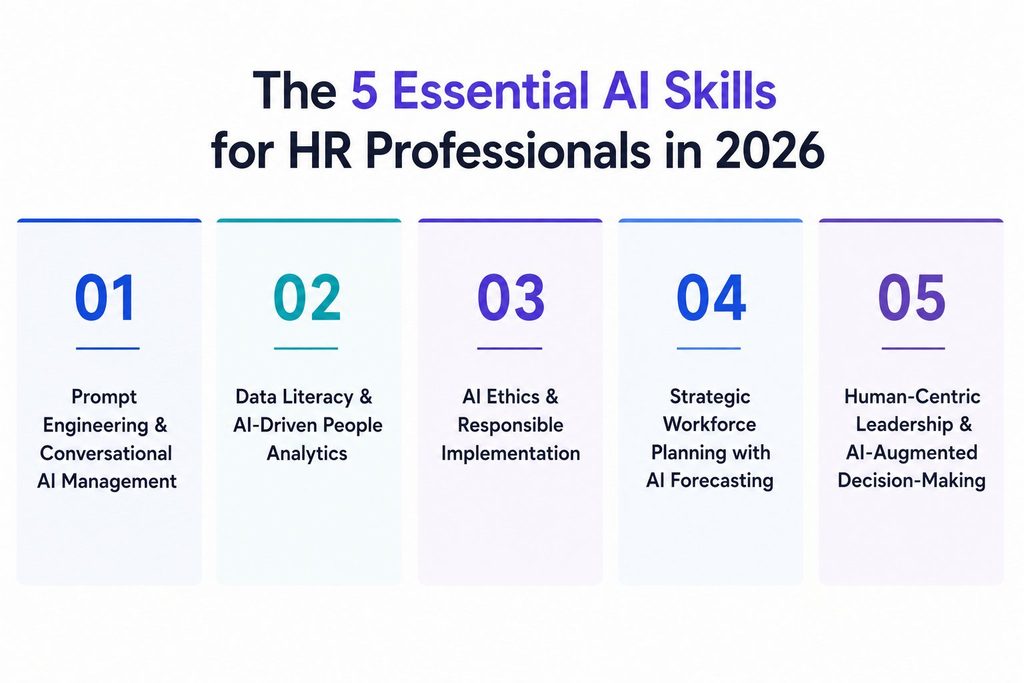
The 5 Essential AI Skills for HR Professionals in 2026
- Prompt Engineering & Conversational AI Management
- Data Literacy & AI-Driven People Analytics
- AI Ethics & Responsible Implementation
- Strategic Workforce Planning with AI Forecasting
- Human-Centric Leadership & AI-Augmented Decision-Making
Prompt Engineering & Conversational AI Management
This is the ability to create clear and specific instructions that cause AI tools to generate genuinely useful output, for example job descriptions, drafts of policy documents, communications to employees and interview guides.
The importance lies in the fact that a generic prompt leads to generic results, which are often useless, while a well-designed prompt yields output that is nearly ready to use; this is the quickest method of regaining hours during an HR week.
For example; Instead of just writing Job Description: Sales Manager as a prompt, write this below
We are looking for a sales manager to lead our sales team. You will set sales goals and create plans to reach them. You will hire, train, and guide sales staff. You will watch sales numbers and find ways to improve results. You will talk with customers and handle complaints. You will work with other teams to help meet company targets. You should have experience in sales and know how to lead a team. Good communication and problem-solving skills are important.
The job description is for a B2B SaaS sales manager working in the mid-market sector, with at least five years’ experience and a hybrid work arrangement based in Chicago. Coaching abilities should be stressed rather than individual quota achievement. The tone should be direct and free of corporate jargon. The description must include a statement on diversity, equity, and inclusion and state the salary openly.
The way to develop this skill is create for yourself a personal “prompt library” consisting of your most effective prompts for various HR tasks such as job advertisements, offer letters, performance review phrases and policy summaries, then improve them on a monthly basis
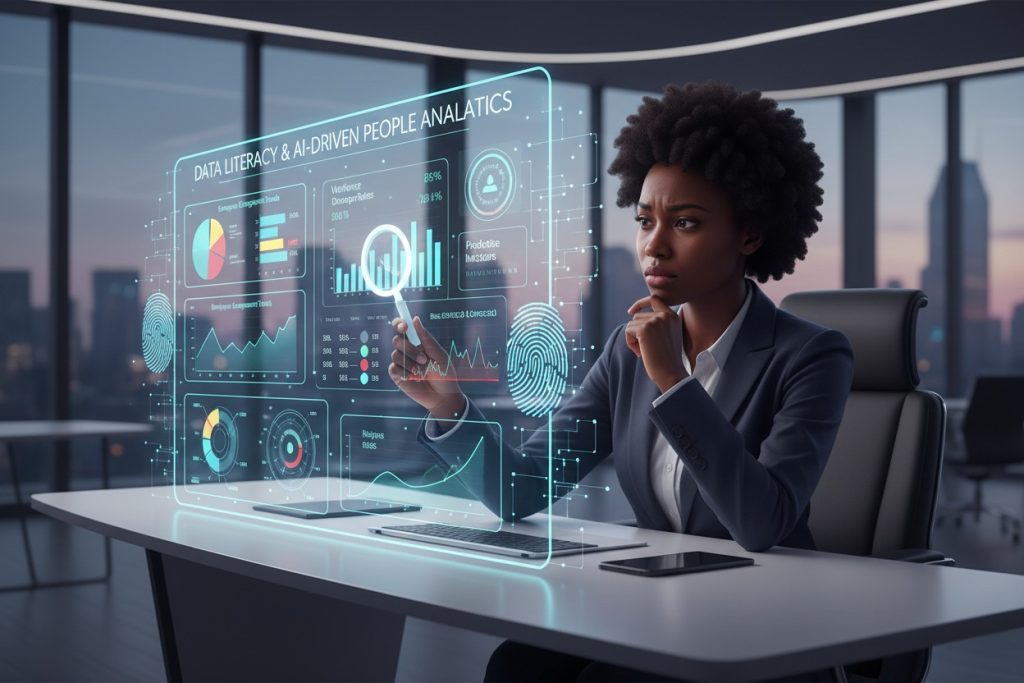
Data Literacy & AI-Driven People Analytics
What this entails is the capability to read, question and take action on data about AI-generated people, such as attrition models, engagement scores and skills-gap dashboards, rather than simply accepting the outputs as they are.
The importance lies in the fact that AI models are only as good as the data and the assumptions upon which they are based; an HR professional who is unable to understand a confidence interval or to identify a biased sample will either place too much trust or too little trust in the tool, which can result in costs.
The following should be noted: there is a real and well-documented risk of algorithmic bias in the field of people analytics. Historical data on hiring or promotions usually contains traces of past discrimination; if this data is fed into a model without critical evaluation, the artificial intelligence will reproduce and amplify that bias. Literacy regarding data is not merely a technical ability, it is also a form of protection.
Here is how to do it: Begin on a small scale by selecting one of the HR dashboards that already exists (for example, the one showing turnover by department, time-to-hire, and engagement trends) and practice explaining the things that the data does and doesn’t prove before incorporating AI-generated predictions.
AI Ethics & Responsible Implementation
What this means is that people need to understand the bias, privacy and transparency responsibilities involved in using AI for making personnel decisions, as well as the regulatory environment that determines these responsibilities, for example the EU AI Act, which regards many HR applications (such as hiring, promotion and termination) as “high-risk.”
It matters because regulators are acting more quickly than most HR departments. Nowadays, high-risk AI systems that are used in making employment decisions will increasingly need to be accompanied by documentation, involve human supervision and include audit trails. HR professionals who grasp this at present will be in a position to prevent last-minute rushes and will avoid having their organisations exposed legally.
Here is a useful piece of advice: carry out an “AI Bias Audit” on the recruiting or performance tools you currently use. Retrieve the broken down outcome data, categorized by gender, race, age and disability status where legally allowed related to decisions influenced by AI and examine it for any disparate impact. It is important to record the process, even if the audit is just a basic one, as this shows a genuine commitment to good-faith governance.
How to do this: Keep up with the regulatory updates in your area, enroll in a short course on AI governance and establish a relationship with your legal or compliance team before it becomes necessary.
Strategic Workforce Planning with AI Forecasting
What this involves is using predictive AI tools to model the future talent requirements so as to identify where skills gaps are likely to appear, which roles are at highest risk of attrition and whether the organisation is over- or under-resourced.
The importance lies in the fact that reactive human resources meaning hiring only when a job vacancy arises is becoming an increasing competitive disadvantage. By using AI to forecast future needs, HR is able to shift from merely reporting on the past to planning for the future, which is precisely the strategic role most HR leaders say they would like to have at the leadership table.
As a practical measure, create a “Talent Risk Register” which is a dynamic document listing your most risky positions, the reasons identified by AI for those risks (such as a compensation gap, manager turnover or skills becoming obsolete) and a person responsible for mitigating each of them. Update this document every quarter by using the AI-generated signals on attrition.
Way to develop it: Collaborate with finance or operations teams who currently use forecasting tools, since the modelling logic can be directly applied to workforce planning.
Human-Centric Leadership & AI-Augmented Decision-Making
What this means is the ability to know when it is necessary for a human to carry out a gut check on an AI’s recommendation, along with the emotional intelligence to act on things that the data cannot see.
The importance lies in the fact that this is the ability which finally distinguishes HR leaders from HR technicians; while AI can identify a pattern it cannot pick up on the atmosphere, detect a pause or grasp a personal crisis.
An AI retention model identifies a high-performing employee as being at risk of leaving because of decreasing login activity and slower response times. A manager who has a technical background would probably offer the employee a retention bonus. A leader who puts people first, however, takes further steps and finds that the employee is dealing with a family health emergency and is not looking for a new job. The AI detected the sign; it was the human who discovered the truth.
Develop it by pairing each AI insight with one actual conversation with a human before taking any action; make this pairing a rule that always applies, not something that is an exception.
How to Build Your AI Skills Road map
A 90-Day AI Upskilling Plan
From day 1 to day 30 (Foundation): finish one introductory AI course and spot three HR tasks that could be automated or enhanced right away.
From day 31 to day 60 (during the application phase): create your own personal library of prompts, carry out a small people-analytics project (even if this involves just one dashboard) and get hands-on experience with at least two AI tools.
From day 61 to 90 (Integration): Submit to leadership one opportunity involving AI together with a business case and draw up a first version of an AI ethics or usage policy for your team.
Best Free and Low-Cost Resources
There are courses available on Coursera, edX and Google’s “AI for Everyone” that provide accessible entry points for those without technical knowledge.
The SHRM forums that focus on AI and the HR Tech communities are useful for obtaining advice from other members and for getting advice that is independent of any vendor.
The following tools are worth trying: ChatGPT, Claude, Perplexity and Microsoft Copilot all have different advantages that should be put to the test with actual HR tasks.
Conclusion
AI is not intended to replace HR; instead, it is meant to eliminate the routine tasks so that HR can focus on the aspects of the job which only humans are capable of carrying out: judgment, empathy, ethics, and strategy. The people who will succeed in 2026 won’t be those who oppose AI or those who accept it without question; they will be those who develop both technical proficiency and strong human skills together.
The good news is that you won’t need a degree in data science or two years’ time to achieve it. Begin your 90-day AI upskilling plan now; 2026 is nearer than you might think.