
Introduction
Applying to pitch at an HR tech festival is mostly a screening exercise, and the form itself is the first test you take. You register, fill a tightly capped application (most fields allow roughly 100 words), upload a pitch deck, share a working demo link, and wait for a selection panel to decide if you make the preliminary round. Startups that are young, funded below a ceiling, and squarely inside HR technology tend to get through. Everyone else gets a polite email.
Fair warning before we go further. I am working from the HR Tech Festival Asia Pitchfest materials, plus coverage of the HR Technology Conference’s PitchFest in the US, and organisers change dates, fees and caps every year. Treat my numbers as patterns, then confirm on the official portal. Also, “HR Tech Festival” is not “HR Tech Europe” or a random startup world cup qualifier. Different organisers, different forms. Check which one you are actually applying to.
What Does It Take to Pitch at the HR Tech Festival?
Short answer: a young company, a real product, and a clear HR problem. That’s the bar.
Eligibility Rules
Organisers want founders who can stand on a stage and show something that exists. An idea scribbled on a napkin rarely survives. The application portal sorts product maturity into tiers, from “Idea stage” and “Prototype developed” to “Private Beta” and “Public Beta Launched”, and I would not apply from the bottom tier unless the festival explicitly runs a separate early-stage track. A working beta with a few paying users beats a glossy concept every time.
Be honest about where you sit. Panels read hundreds of these, and inflated claims leak out fast.
Startup Stage and Funding Limits
Most tech festival stages cap eligibility at companies under about five years old, with a funding ceiling often set near $10 million (roughly ₦15 billion at recent exchange rates, though the naira moves, so check the day you read this). Late-stage firms with big Series B cheques are usually pushed to exhibitor booths instead. That is a cost for them, and a gift for you, because the stage is meant to protect the underdog.
If you are a Lagos or Nairobi founder eyeing a Singapore stage, the same rules apply. Nobody gives out geographic discounts, but nobody blocks you either.
HR Domain Fit
“We do AI” is not a domain. Panels look for a specific alignment: talent analytics, recruitment automation, payroll, workforce management, employee engagement, agentic AI for HR operations. Your pitch must tie to a pain that HR buyers are losing sleep over right now. A generic productivity tool with an HR label slapped on will get filtered early.
How Do You Apply for the Pitch Stages?
You apply online, through the festival’s own application portal, and the order matters more than people admit.
Registration Steps
Here is the sequence I would follow, and I would not skip any of it:
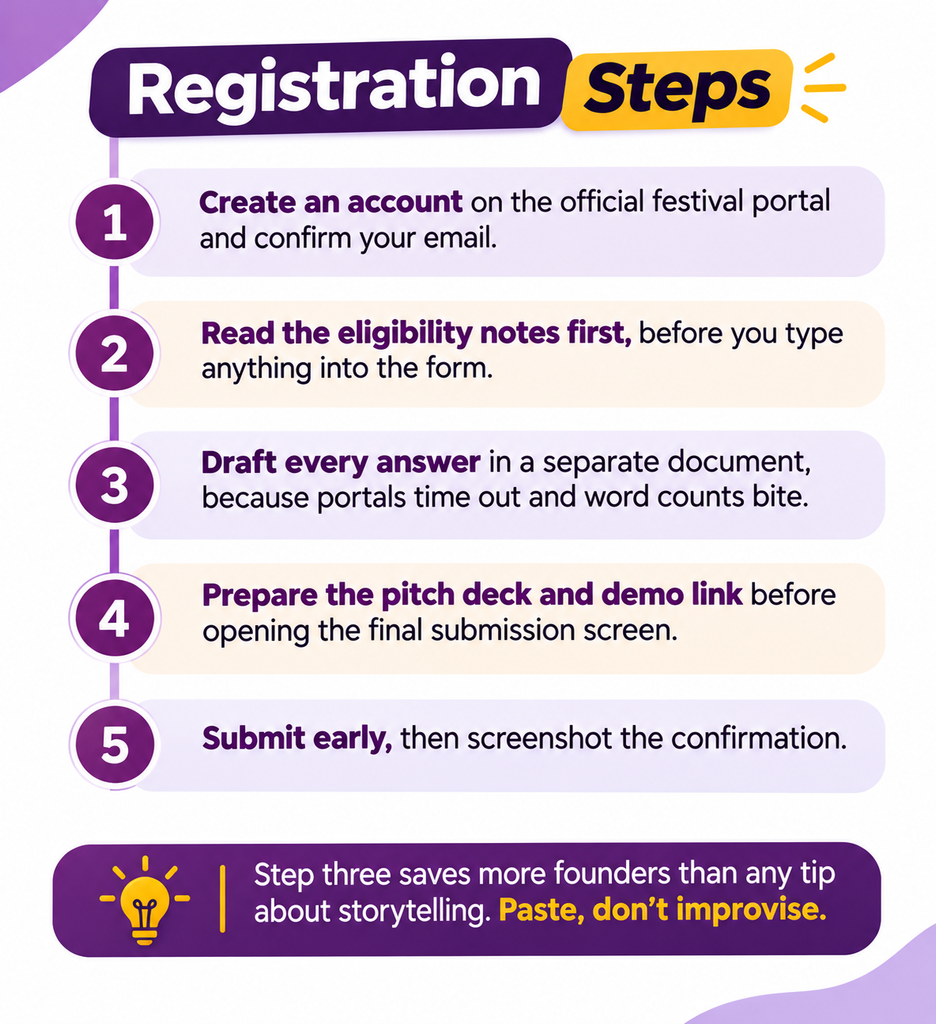
- Create an account on the official festival portal and confirm your email.
- Read the eligibility notes first, before you type anything into the form.
- Draft every answer in a separate document, because portals time out and word counts bite.
- Prepare the pitch deck and demo link before opening the final submission screen.
- Submit early, then screenshot the confirmation.
Step three saves more founders than any tip about storytelling. Paste, don’t improvise.
Application Deadlines
Deadlines vary by year, and some festivals run rolling reviews before a hard cut-off. For the Asia edition, application windows have historically opened months ahead of the event. I cannot give you a date that stays true, so I will say this: treat the published deadline as a week earlier than it reads. Portals crash on the last night. Time zones also bite, since a Singapore deadline lands at a very odd hour in Lagos.
Fees and Contacts
Pitch applications at these festivals have often been free to submit, with costs arriving later through festival passes or travel. Do not assume that, though. Some organisers charge a small processing fee or require a delegate ticket. If the fee line is unclear, email the organiser’s startup or programme team, which is listed on the festival site, and ask in writing so you have a record. Budget separately for flights, accommodation and visa fees, which often dwarf any application charge for founders based in Nigeria.
Which Documents Must You Submit?
Three buckets: the form, the deck, and proof your product works.
Application Form Fields
The official application form blueprint and submission fields show what you will face: an elevator pitch capped at 100 words, team size, a problem statement, target market and ideal customer profile, a unique selling proposition against at least two competitors, a competitive advantage summary, a monetisation model, a 12-month product roadmap, and total revenue over the past year in US dollars.
Each text box is brutal on length. Write 140 words, cut to 100, then cut again. Revenue must be accurate, because vague figures on revenue or market size are the quickest route to disqualification.
Pitch Deck
Decks are mandatory uploads. Core components follow the festival’s own guidance: problem and opportunity, leadership profiles, competitive mapping, and a monetisation plan. Keep it light. Guy Kawasaki’s 30-point minimum font rule is a decent check, since a back-row delegate must read your slide from across a hall. If you need six lines of bullet points, you need a different slide.
Demo Link and Supporting Files
Include a working demo link, ideally a short walkthrough video or a sandbox login that does not require a call to unlock. Judges click once. If it breaks, they move on. Add a one-page customer proof sheet if the portal allows extra files, and keep file sizes small.
How Do the Pitch Rounds Work?
Expect a fast preliminary blitz, then a longer final, with questions at both stages.
Preliminary Round
Semi-finalists generally get two to three minutes on stage, followed by a short Q&A. That is nothing. You get one problem, one proof point, one ask. At the US PitchFest, around 30 semi-finalists have been selected in recent years, according to the 2026 PitchFest prize pool and winner roster, so the field is crowded and the clock is unforgiving.
Final Stage
Finalists receive a longer block, often five to ten minutes on the main stage. The early Asia edition ran tighter. Coverage of the inaugural event shows how Gpayroll beat 19 other startups in a five-minute format. Five minutes, twenty companies. Think about that.
Q&A Panel
The questions come from a mixed bench of corporate HR leaders, tech accelerators and venture investors, and they are not gentle. Reports on the live Q&A cross-examination describe judges probing pricing, churn, data security and who actually buys. Have crisp answers on all four.
How Are Pitches Judged and Rewarded?
Scores blend expert opinion with audience reaction, and the prize pool is real money.
Judging Criteria
Typical criteria cover problem clarity, product maturity, market size, traction, team and the quality of your answers under questioning. Panels look at whether the pain is urgent, whether buyers pay, and whether you can grow without burning cash.
Audience Choice
Live audience voting counts for 30% of a startup’s final score in the US format, with panellists covering the remaining 70%. So charm matters, but it cannot rescue a weak business. An audience-choice award also exists separately.
Cash Prizes and Booth Space
The 2026 US edition offered $25,000 for first place, $10,000 for second and $5,000 for audience choice. That is roughly ₦37.5 million, ₦15 million and ₦7.5 million at approximate rates, though again, check the current exchange rate. Some festivals add booth space or exhibitor passes. The cash matters less than the exposure, honestly. Steve Boese, an event co-chair, has pointed out that pitch stages put early-stage tools directly in front of venture investors and corporate HR buyers, which is where your next ten customers hide.
How Do You Prepare a Pitch That Wins Investment?
Treat the stage as a sales call that happens to have 500 witnesses.
Lead With Strong Data
Open with your best number. Not a story about your childhood, not a market-size slide that says “trillion”. If you have 40 paying clients or a 30% cut in time-to-hire, say it in the first ten seconds. Practical guides like Techpoint Africa’s key pitch elements say the same: clarity and proof first.
Map Competitors Honestly
Never claim zero competition. Investors hear that and quietly close their notebooks. Show how customers cope today, whether through spreadsheets, a manual HR officer, or a rival platform, then show why your route is faster or cheaper.
Rehearse Against the Clock
Run it with a timer, then with a stranger, then with a friend who will interrupt you. Cut anything that survives only because you love it. Guidance on preparing for your first pitch competition leans hard on repetition, and I agree, since nerves eat memory first.
What Should You Protect Before Pitching on Stage?
Your intellectual property, your customers’ personal data and your cap table story. File trademarks or at least document your code ownership before the event. Never show real employee records in a demo, because HR data is sensitive and privacy law (Nigeria’s NDPA 2023 included, plus GDPR for European clients) applies to you. Use dummy data. Also confirm what you say on stage is recorded and may be shared, so keep unpublished pricing or pending contract names out of the room.
Which Mistakes Get Applications Rejected?
A handful repeat themselves. Overstuffed answers that ignore the word cap. Missing competitors. Revenue stated loosely. A demo link that asks for a password nobody supplied. A deck stuffed with tiny type. And applications sent at 11:58 pm on deadline night, when the portal chokes.
One more: sending a product that is not really for HR. Panels notice.
FAQ
Is there a fee to apply? Often not for the application itself, but confirm with the organiser, since passes and travel add cost.
How long is the pitch? Usually two to three minutes in preliminaries and up to ten for finalists, depending on the edition.
Can a non-US or non-Asian startup apply? Generally yes, provided you meet stage, funding and HR-domain rules.
What if I have no revenue yet? State zero honestly, then show pilots, letters of intent or usage numbers.
Who do I contact with questions? The festival’s startup or programme team, listed on the official site.
Conclusion
Getting onto an HR tech pitch stage takes discipline more than genius. Meet the eligibility rules, respect the 100-word caps, upload a tidy deck, ship a working demo, and rehearse until the clock feels like a friend. Then walk up and sell.
So, which part of your application worries you most?