
A long-term HR innovation program is planned in three moves: tie it to a business outcome, fund it in phases with a contingency reserve, and govern it through a small steering group that meets on a fixed calendar and can actually say no. Everything else is detail.
Most HR teams start at the wrong end. They buy a platform, announce a “people transformation,” and then wonder, eighteen months later, why the money is gone and the managers still run appraisals in spreadsheets.
Sound familiar?
I have watched this play out in Lagos boardrooms and Los Angeles ones, and the pattern barely changes. Big vision. Thin plan. Nobody owning the awkward bits.
The good news is that planning an HR innovation program is not mysterious. It is just unglamorous, and unglamorous work is where most organizations cut corners.
So let’s not cut them.
What Does a Long-Term HR Innovation Program Involve?
Scope and Boundaries
Start by saying what the program is not. It is not a single software rollout, and it is not a rebrand of your normal HR operations with a shinier slide deck. A real program bundles several linked initiatives, say a skills framework, a learning platform, redesigned performance management, and maybe workforce analytics, all aimed at one shift in how the organization attracts, grows, and keeps talent.
Draw the fence early. If payroll reform is inside the fence, say so. If it is outside, say that too, loudly, because scope creep loves a quiet room.
Typical Time Horizon
Three years is a sensible default for most mid-sized organizations. Two feels rushed once you count procurement, change management, and one full performance cycle. Five is usually fantasy, because the business will have changed shape before you finish.
I’d rather commit firmly to twelve months and sketch the rest in pencil. Planning every detail across three years is mostly a waste of time, since the plan will meet reality and get wrecked.
Common Failure Points
Programs rarely die from bad ideas. They die from vague goals, no clear owner, budgets that assume everything goes smoothly, and sponsors who vanish after the kickoff.
There is also the planning fallacy, the stubborn human habit of underestimating how long tasks take and how much they cost, even when we have been burned before. HR is not immune. If anything, we are worse, because people work is soft and soft work feels quicker than it is.
How Do You Set Clear Goals for HR Innovation?
Link Goals to Business Outcomes
Ask the finance director what keeps them awake. Turnover in sales? Slow hiring of engineers? Managers who cannot coach? Your goals should hang off that answer, not off whatever HR conference you attended last quarter.
“Launch a learning platform” is an activity. “Cut time-to-productivity for new sales hires from five months to three” is an outcome somebody in the C-suite will defend in a budget meeting.
Write SMART Targets
SMART (Specific, Measurable, Achievable, Relevant, Time-bound) sounds like management-course furniture, I know. Yet the evidence is stubborn. Research on clear and challenging goals keeps finding that specific targets lift performance compared to loose intentions. A well-known goals study went further: people who wrote goals down, committed to actions, and sent weekly progress updates to a friend scored 7.6 out of 10 on achievement, against 4.28 for those who kept goals in their heads.
Now swap “friend” for “steering committee” and you have the logic of program governance in miniature.
Define Success Metrics
Pick few. Five to seven is plenty. Mix leading indicators (training completion, manager adoption of the new process) with lagging ones (regret attrition, internal fill rate, engagement scores, cost per hire).
And set the baseline before you touch anything. I have seen programs celebrate a 12% improvement against a number nobody had measured beforehand. Awkward.
How Do You Plan the Program Roadmap?
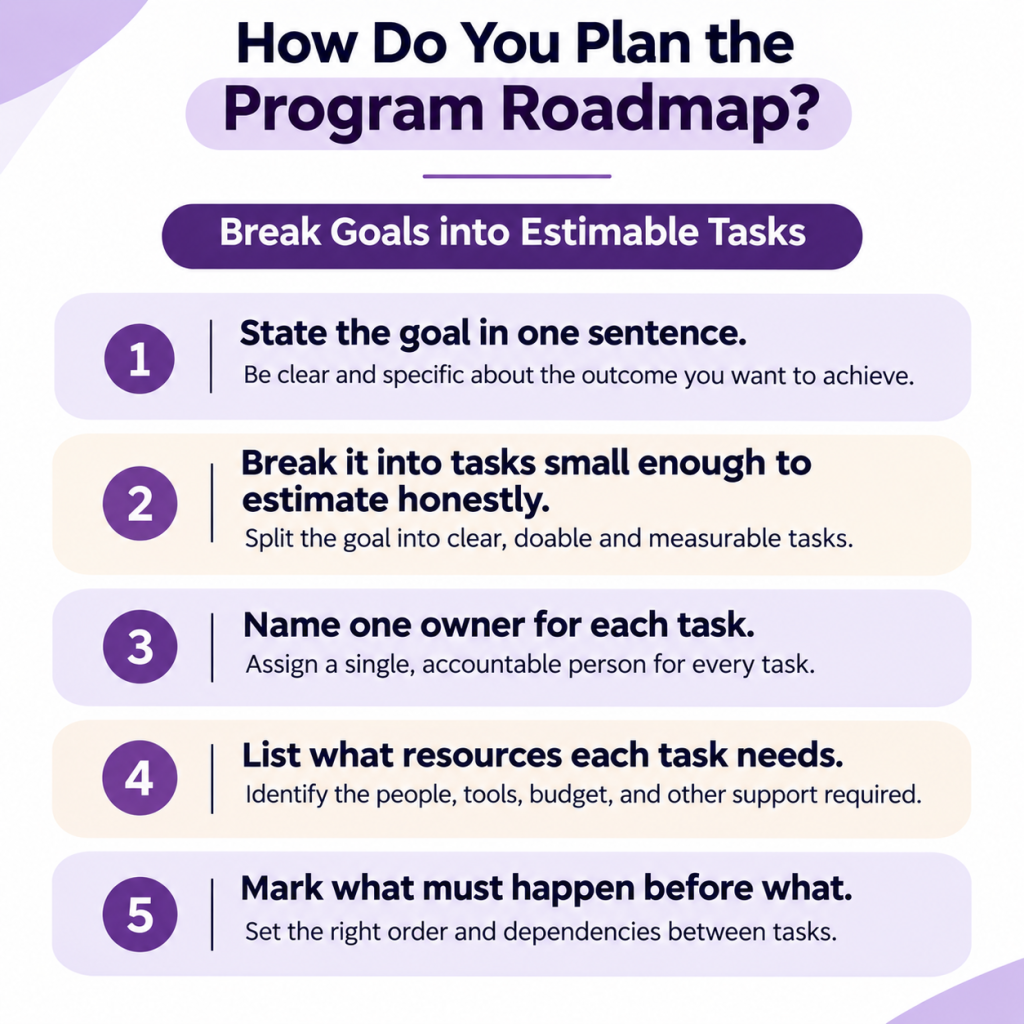
Think of the roadmap as a rough route rather than a GPS voice that never lies. Here is the sequence I keep coming back to:
- State the goal in one sentence.
- Break it into tasks small enough to estimate honestly.
- Name one owner for each task.
- List what resources each task needs.
- Mark what must happen before what.
Break Goals into Estimable Tasks
Use a Work Breakdown Structure. Take “redesign performance management” and keep slicing: interview twenty line managers, draft the new rating philosophy, pilot it in one department, adjust the forms, train reviewers. When a task reads like something one person can estimate in days or weeks, stop slicing.
Coursera’s guide to project plans makes the same point about breaking outputs into estimable units before touching deadlines. Dates come last. Not first.
Assign One Owner per Task
Committees do not complete tasks. People do. If a task has no clear owner, it is wishful thinking with a due date attached.
One name per task, even when five people contribute. That single name answers the question “who do I chase?” and it makes accountability visible without anyone having to be dramatic about it.
Map Dependencies and Sequence
You cannot launch skills-based hiring before the skills taxonomy exists. You cannot train managers on a new appraisal form that legal has not cleared. Draw the dependency lines on a wall, a whiteboard, or a Gantt chart, whichever your team will actually look at.
Then find the critical path, the chain of tasks that sets your end date. Slip anywhere on it and the whole program slips. Everything off that path has some breathing room.
Involve Stakeholders Early
Planning people’s working lives for them, instead of with them, is how programs get quietly sabotaged. Communicative planning theory has argued this for decades: those affected should help shape the schedule and deliverables.
In practice, that means early conversations with line managers, union or staff association representatives where they exist, IT, legal, finance, and a handful of ordinary employees. Not a survey sent in month nine. A real conversation in week two.
Agilemania’s planning guide notes that identifying stakeholders and communicating early limits misalignment downstream. I’d go further. Skip this and you will pay for it twice, once in rework and once in trust.
How Much Should You Budget, and How?
Cost Categories
Budgeting for a multi-year program is easier when you sort money into honest buckets. Technology licences and integration are the obvious ones. Less obvious: internal staff time (the expense everyone forgets), external consultants, training and learning content, communications, data cleanup, and the ongoing run costs after launch.
| Category | What it covers | Common blind spot |
|---|---|---|
| Technology | Licences, integration, security reviews | Annual renewal increases |
| People | Project team, backfill for seconded staff | Unpaid overtime |
| Change and learning | Training, manager coaching, comms | Cut first when money tightens |
| Data | Cleanup, migration, analytics | Underestimated by half |
| Run costs | Support, upgrades, vendor management | Missing from the business case |
Count the full cost of ownership, not the launch bill.
Phased Funding
Release money in tranches tied to evidence. Fund discovery and a pilot first, then the wider rollout once the pilot proves something. This is how a sensible finance office treats any capital project, and honestly HR should welcome it. Phased funding protects you from the nightmare of a three-year commitment built on one optimistic forecast.
Each tranche gets a gate: results reviewed, lessons logged, next amount approved or trimmed.
Contingency Reserve
Hold back 10% to 20% of total cost. Go toward 20% if your data is messy, the vendor is new to you, or your organization has a record of failed change efforts. Keep the reserve under the sponsor’s control, not the project manager’s pocket, so drawing on it is a visible decision.
Do not call it padding. It is the price of being honest about uncertainty.
How Do You Govern the Program?
Governance sounds heavy, but it comes down to three questions: who decides, how often, and on what evidence.
Set up a steering group of five to eight people, led by an executive sponsor, with finance, IT, and a respected line leader at the table. Meet monthly. Give it real authority over scope, funding gates, and the contingency reserve. A steering committee that only receives updates is a theatre audience.
Underneath sits a program office or a lead (even one capable person) who keeps the plan, risk log, and decision log current. A single-page dashboard each month beats a forty-slide deck nobody reads. Show progress against metrics, spend against budget, top five risks, and decisions needed.
The Project Management Institute has long reported that organizations with weak alignment between strategy and delivery waste far more of their project money. That is a governance problem dressed as a delivery problem.
Choose Planning Methods and Tools
Pick the method that fits your culture, not the one that looks best on LinkedIn. A hybrid usually wins for HR: waterfall-style structure for fixed things like legal compliance and budgets, agile sprints for things that need testing with real users, such as a new onboarding journey.
Tools matter less than people think. A shared spreadsheet, a Kanban board, or a proper project platform can all work if people update them. For individual planners on the team, a daily planning habit helps: three priorities each morning, a weekly review each Friday, a theme word for the month if that suits you. Small stuff, yes. Yet habits take a while to stick, and the University College London habit research found anywhere from 18 to 254 days, averaging 66, before a routine turned automatic. So do not judge your system in week two.
How Do You Stay on Track and Adjust the Plan?
Review regularly and change the plan when the facts change. That is the whole trick.
Run a short weekly check at task level and a monthly review at program level. Ask what shipped, what slipped, what we learned, and what we should stop doing. Log risks openly. When a pilot reveals that managers hate the new form, that is data, not betrayal.
To keep energy up, share progress publicly. Celebrate small wins like the first department live on the new system. And build in what researchers call implementation intentions: specifying exactly when, where, and how a step will happen makes people far likelier to do it. Pair that with coping plans, which health behaviour research links to better goal attainment, and you get an “if this blocks us, we do that” habit across the team.
A plan should help you decide what to do next. It should not become a sacred document everyone is scared to touch.
What Should You Ask Before Scaling the Program?
Before you extend a pilot to the whole workforce, pause and push on a few questions.
Did the pilot move the metric we cared about, against the baseline? Would the managers who used it choose to keep it? What did it really cost per employee, including the hidden time? Can our infrastructure, data quality, and support team handle ten times the users? Who owns it after the project team disbands?
If you cannot answer two or more, you are not ready. Fix those first. Scaling a shaky pilot just multiplies the shakiness, and now more people are watching.
Conclusion
Planning a long-term HR innovation program comes down to a handful of stubborn habits. Anchor goals to business outcomes. Break them into tasks with single owners. Involve the people affected, early. Fund in phases, keep a contingency, and give your steering group genuine teeth.
Then review, adjust, repeat.
Skip the perfect plan. Build a workable route, check it often, and be brave enough to change it.
So what is the one task in your current HR plan that has no real owner?