
The balance of power in the workplace has shifted permanently. In 2026, employees have more visibility into company culture, more transparency into how their peers are treated and more willingness to leave than at any point in recent memory. Toxic management behavior remains the single most consistently cited driver of voluntary turnover across employee surveys and exit interviews.
This means the modern people manager’s job isn’t just to build a great team through inspiring leadership. It is equally about avoiding the specific, predictable mistakes that quietly erode trust, motivation and retention. Organizations like HR Expo Africa work with HR leaders every day to help them spot these exact risk patterns before they become resignation statistics. Below are the seven behaviors that no people manager should carry into 2026, each grounded in real, observable workplace patterns.
1. Never Delegate On-boarding
Too many managers treat on-boarding as something HR “handles.” That is the first mistake. On-boarding is a direct leadership responsibility, the first 90 days set the tone for an employee’s entire tenure and managers who show up only after paperwork is done are already behind.
Unstructured on-boarding is strongly linked to early disengagement and elevated 90-day attrition. When new hires spend their first weeks unsure of expectations, priorities or who to ask for help, they mentally check out before they have even started contributing.
The industry has moved decisively toward structured, often automated on-boarding frameworks as the new success benchmark, not because automation replaces human connection but because it guarantees consistency. A manager who never delegates the relationship of on-boarding (even while using tools to handle logistics) should have:
- A clear Day 1 plan
- A documented 30-60-90 day road map with specific milestones
- Scheduled check-ins in week one
If on-boarding is the only touch-point a manager skips, it is usually the one that costs the most.
2. Never Ignore the “Feedback Void”
Silence is not neutral. When employees don’t know where they stand, the brain treats that ambiguity similarly to a perceived threat triggering low-grade, sustained stress that damages both well-being and performance. Managers who rely on a single annual review to communicate performance are, in effect, leaving employees in a feedback void for 51 weeks a year.
Across social platforms, professional forums and engagement surveys, “I never know how I am doing” is consistently one of the most repeated employee complaints. This is more common than complaints about pay or workload.
The fix is not complicated, but it requires consistency.
- Weekly 1:1s should be short, focused and non-negotiable
- We should recognize real-time praise promptly as soon as it is earned.
- Mid-cycle check-ins like informal progress conversations between formal reviews
By 2026, organizations must use a steady feedback cadence. It becomes the baseline for a workforce accustomed to instant digital feedback loops.
3. Never Treat Your Team as “Output Machines”
Managers who measure people purely by hours logged or tasks completed are making a strategic error. Well-being neglect is a business risk with a direct line to burnout, disengagement and the kind of attrition spikes seen during the great Resignation.
Output-only management creates a short-term illusion of productivity. Deadlines get hit, tickets get closed but the underlying capacity of the team is quietly being drained. Eventually, that debt comes due in the form of quiet quitting, sick leave spikes or sudden resignations from top performers who feel used rather than valued.
Contrast two management styles:
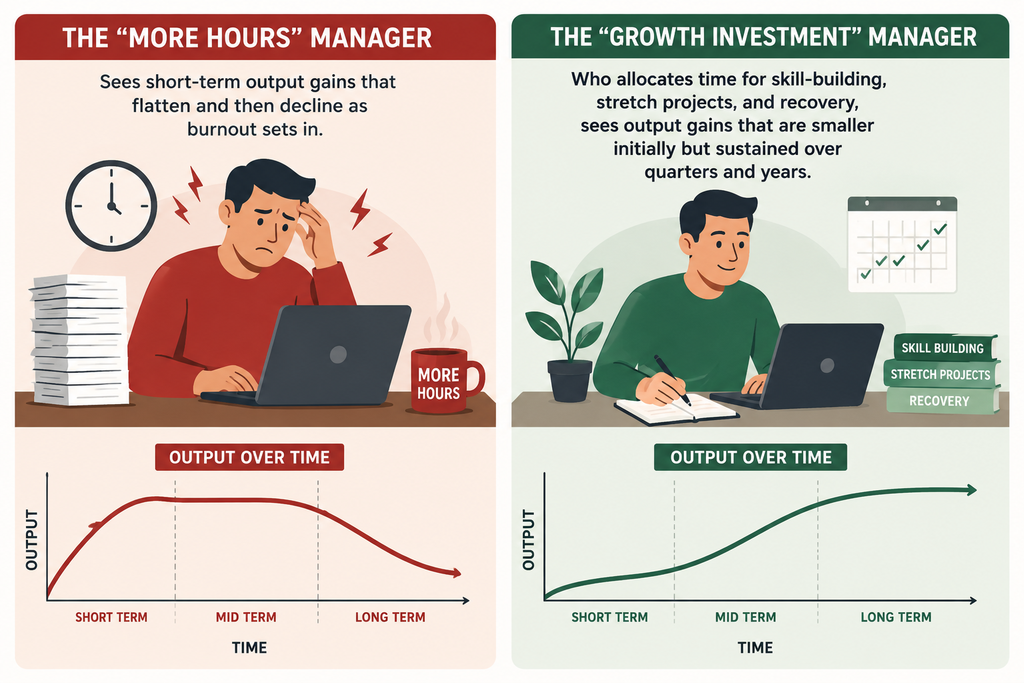
The “more hours” manager sees short-term output gains that flatten and then decline as burnout sets in.
The “growth investment” manager who allocates time for skill-building, stretch projects and recovery, this manager sees output gains that are smaller initially but sustained over quarters and years.
Well being and output aren’t opposing forces. In 2026, the managers who understand this distinction will retain their best people; the ones who don’t will keep hiring to replace them.
4. Never Micromanage in a Hybrid World
Hybrid and remote work didn’t create micromanagement, it just made it more visible and more damaging. There is a critical difference between healthy oversight (regular check-ins, clear expectations, visibility into progress) and toxic surveillance (activity trackers, keystroke logging, constant status-checking).
Micromanagement sends an unmistakable signal: “I don’t trust the decision to hire you.” That message, repeated daily through excessive monitoring, is one of the fastest ways to destroy psychological safety on a distributed team.
The healthier framework is “trust but verify” through outcomes, not activity:
- Measure deliverables what was produced and to what standard
- Set clear deadlines and let employees determine their own workflow
- Reserve check-ins for support and unblocking
Managers who focus on outcomes over hours-logged consistently report higher team trust scores and lower turnover among their highest performers, who are often the most sensitive to being micromanaged.
5. Never Play Favorites
Favoritism in 2026 rarely looks like overt bias, it is almost always subtler than that. It shows up as in-group/out-group dynamics: the manager who unconsciously gravitates toward employees who share their communication style, background or working hours.
A common, concrete example: the best projects consistently go to whoever speaks up loudest in meetings, not necessarily to the most qualified person. Managers overlook quieter, equally capable team members, not out of malice, but out of habit.
The fix isn’t relying on individual willpower or good intentions. It’s standardizing the process:
- Use documented, criteria-based project assignment
- Apply consistent, transparent promotion criteria across the whole team
- Periodically audit who gets high-visibility work and who doesn’t
Unconscious bias is best addressed with structure, not just self-reflection because self-reflection alone rarely catches patterns that feel, from the inside, like simply “trusting your gut.”
6. Never Take Credit for Your Team’s Work
Attribution bias is well documented: leaders tend to overestimate their own contribution to team wins, often without realizing it. Left unchecked, this becomes a pattern where the manager’s name is attached to every success while the actual contributors go unmentioned.
The contrast is stark. A “credit thief” presents team output as personal achievement in front of senior leadership. A “sponsor” does the opposite, actively naming and promoting team members’ work upward, even when it costs them a moment of personal spotlight.
This isn’t just a matter of manners. Credit-taking culture is measurable: it shows up directly in declining engagement survey scores, particularly on questions related to recognition and fairness. Sponsorship behavior, by contrast, is one of the most reliable predictors of retention among high performers.
7. Never Stop Learning
Perhaps the most dangerous mistake is assuming the management style that worked in 2020 still applies unchanged today. The workplace has changed; hybrid norms, generational expectations and AI-assisted tools have all reshaped what good leadership looks like.
Managers who ignore AI-assisted feedback, coaching and performance tools aren’t just missing efficiency gains, they risk falling meaningfully behind peers who use these tools to give faster, more consistent, more personalized support to their teams.
The “I know best” fallacy is itself a leadership risk. Great managers in 2026 treat their own craft the way they expect their teams to treat skill development: as a continuous, non-negotiable practice, not a box checked once during initial training.
Conclusion
None of these seven mistakes require a personality overhaul to fix. Delegated on-boarding, feedback voids, micromanagement, favoritism, credit-stealing and stagnant leadership habits are largely process failures which means they are fixable with the right structure, consistency, and self-awareness.
You don’t need to fix all seven at once. Pick one mistake. Eliminate it this quarter. Your team will notice often faster than you expect.
Which of these mistakes have you seen most often in your own workplace?